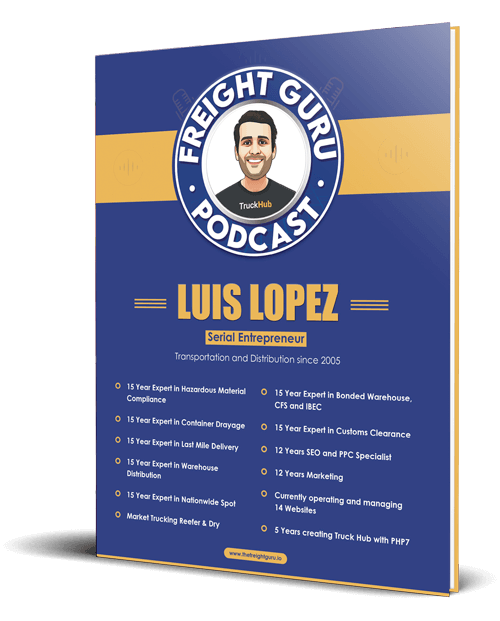
By Luis Lopez, AI transportation consultant, CEO of Go Hub.io Holdings Corp and subsidiaries, and host of the Freight Guru Podcast
A transportation management system, or TMS, is the software that plans, executes and settles freight movements. Some are built for shippers who buy transportation. Others are built for freight brokers and 3PLs who sell it, or for carriers and fleets who run trucks. The same label covers all three, so the first job is to find out which audience a product was designed for.
This article covers ten transportation management systems and says who each one serves.
How this list was put together
Disclosure: Go Truck Hub, listed first, is a product I am affiliated with. The other nine are in alphabetical order and are not ranked. It is based on public information from each vendor’s own website as of October 2026. No vendor paid to be included. Features and pricing change, so confirm the details with the vendor and ask for a trial on your own data before you decide.
1. Go Truck Hub
Go Truck Hub is a cloud-based transportation management system for carriers, brokers, shippers and dispatchers. Its site lists shipment creation, dispatch, real-time tracking, quoting, invoicing, asset management, a driver mobile app and a CRM. It supports container drayage, truckload and last-mile work and lists integrations including DAT, Transflo and QuickBooks.
Website: truckhub.io
Good fit for: carriers and 3PLs that run drayage, truckload and last-mile freight in one system.
2. Alvys
Alvys is a cloud-based platform that combines dispatch, billing, compliance and reporting. Its website says it serves trucking carriers, freight brokers, hybrid asset-based operations and shippers with private fleets. Stated features include load management, a driver mobile app, driver and carrier settlements, native EDI and third-party integrations.
Website: alvys.com
Good fit for: carriers and brokers that want dispatch, compliance and accounting in one system.
3. Blue Yonder
Blue Yonder offers a transportation management solution aimed at shippers with complex transportation networks, such as those in retail and manufacturing. Its site lists network modeling, carrier procurement and bid management, load planning, real-time execution and sustainability reporting.
Website: blueyonder.com
Good fit for: large shippers planning multimodal networks and running carrier bids.
4. Descartes
Descartes lists several transportation management products: a multimodal TMS for shippers, a freight broker TMS, a flatbed TMS and a forwarder TMS. Its site describes mode and carrier selection, shipment visibility, dock appointment scheduling, rate management and ERP integration. The audience spans shippers, brokers, 3PLs and logistics service providers.
Website: descartes.com
Good fit for: shippers, brokers and forwarders that want a product matched to their specific mode or business model.
5. Infios Transportation Management
Infios describes its transportation management offering as serving businesses of varying sizes, from regional distributors to global 3PLs. Its site lists a TMS along with freight audit and payment, claims management, vehicle routing and optimization, shipment visibility and direct store delivery.
Website: infios.com
Good fit for: shippers and 3PLs that want audit, payment and claims alongside planning and execution.
6. McLeod Software
McLeod Software serves truckload carriers, brokers, 3PLs, private fleets and LTL carriers, with products tailored to each segment. Its website lists dispatching, pricing and order management, carrier and driver management, safety and compliance, accounting, native EDI and reporting and analytics.
Website: mcleodsoftware.com
Good fit for: trucking fleets and brokerages that want accounting and operations tied together.
7. PCS Software
PCS Software provides a cloud-based TMS with an AI layer it calls Cortex. Its website names carriers, asset-based brokers, shippers and private fleets as its audience. Stated features include dispatch, fleet operations, accounting, route optimization, real-time tracking, a driver mobile app and integrations with ELDs, ERPs and accounting systems.
Website: pcssoft.com
Good fit for: mid-size carriers and asset-based brokers that want load profitability visible at dispatch.
8. Revenova
Revenova offers a cloud-based TMS built on the Salesforce platform. Its website lists freight brokers, carriers and fleet operators, 3PLs and 4PLs, and shippers as its audience. The product combines CRM and TMS functions and includes multimodal planning, fleet management, analytics and partner integrations.
Website: revenova.com
Good fit for: brokers and logistics providers that already work in Salesforce or want sales and operations in one place.
9. Rose Rocket
Rose Rocket describes itself as an AI-native transportation management platform for carriers, brokers and logistics operators. Its site highlights configurable dispatch workflows, AI agents for order building and exception flagging, custom reporting, rate management, and core TMS functions such as load tendering, track-and-trace and invoicing.
Website: roserocket.com
Good fit for: carriers and brokers that want to configure workflows rather than adopt a fixed process.
10. Turvo
Turvo is a cloud-based TMS focused on collaboration between supply chain partners. Its website names freight brokers, 3PLs, shippers and carriers as its audience. Stated features include order-to-shipment planning and execution, real-time tracking, appointment scheduling, analytics, a driver app and integrations with WMS, ERP and load board systems.
Website: turvo.com
Good fit for: teams that spend a lot of time on check calls and status updates across partners.
How to Choose
- Start with your role. A shipper, a broker and a carrier need different things from a TMS. Shortlist products built for your side of the transaction. If you run trucks, our guide to TMS software for small carriers covers what to look for.
- List your must-have workflows. Write down how loads move today, from quote to invoice. Check each product against that list instead of a feature checklist.
- Check integrations. Ask which ERP, accounting, ELD, EDI and load board connections are included, and which are extra work.
- Ask hard questions about AI features. Find out what the AI actually does, what data it uses and who reviews its output. Our article on how to evaluate an AI vendor for trucking and logistics has a practical set of questions, and the ways AI is changing LTL and truckload shipping shows where it is already in use.
- Run a trial on your own data. Load real orders, rates and customers. A demo with sample data will not show how the system handles your exceptions.
- Plan the switch. Ask about data migration, training time and support, and confirm contract terms in writing.
For more on freight and logistics, subscribe to the Freight Guru Podcast.
About the author: Luis Lopez is a Miami-based AI transportation consultant and logistics entrepreneur, the CEO of Go Hub.io Holdings Corp and subsidiaries, and host of the Freight Guru Podcast.