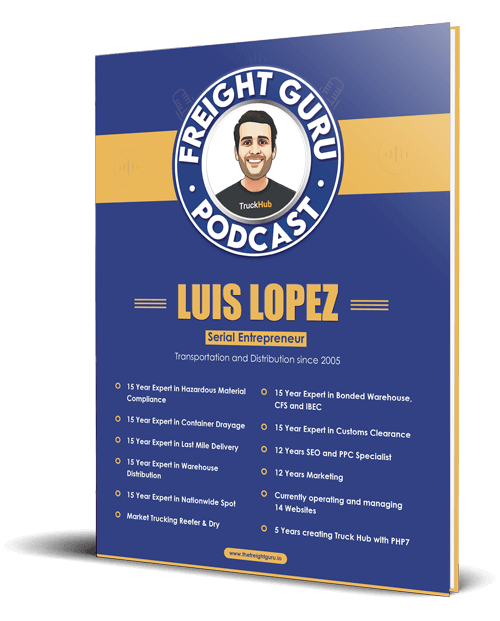
By Luis Lopez, AI transportation consultant, CEO of Go Hub.io Holdings Corp and subsidiaries, and host of the Freight Guru Podcast
Every freight quote starts with a few numbers: how much the shipment weighs, how big it is, how many pieces there are and what the product is. For most shippers, those numbers come from an item master, the product database that holds weights, dimensions, case packs and descriptions for every SKU. When the item master is right, quotes are accurate and bills match. When it is wrong, everything downstream goes sideways.
Item master data is one of the least glamorous problems in logistics and one of the most expensive. It is also a problem AI tools are well suited to help with, because it is mostly about finding patterns and outliers in large tables of numbers.
How bad item data turns into freight cost
A wrong weight or dimension on a single SKU does not look like much. Multiply it across thousands of orders and the costs show up everywhere:
- LTL reweighs and reclasses. When the carrier measures the freight and it does not match the bill of lading, the invoice changes, usually upward.
- Wrong freight class. Density-based classes depend on accurate weight and dimensions. Bad data means the wrong class on the bill.
- Bad quotes. Brokers and carriers price what they are told. A quote based on bad data is either too high to win or too low to cover the real cost.
- Poor trailer planning. Load planning tools that think cartons are smaller than they are build loads that do not fit.
- Warehouse slotting errors. Products assigned to locations that are too small for them slow down picking and cause damage.
The factors that move a freight price are explained in what affects freight quotes, and almost all of them depend on the item master being right.
Why item masters go wrong
Item data usually starts with the manufacturer or supplier, and it degrades from there. Common causes include:
- Supplier spec sheets that list the product dimensions instead of the shipping carton
- Packaging changes that never make it into the database
- Units mixed up between inches and centimeters, or pounds and kilograms
- Case pack quantities that changed when a supplier switched cartons
- Placeholder values entered to get a new SKU set up quickly and never corrected
- Copying data from a similar product instead of measuring
What AI does with item master data
Outlier detection
The simplest and most useful technique is finding values that do not make sense. An AI model can compare each SKU against similar products and flag the ones that look wrong: a case of paper towels that weighs as much as a case of motor oil, a carton with a density that would be impossible for the product inside, or a pallet configuration that would stack higher than a trailer door.
Comparing against measured shipments
Many warehouses and carriers measure freight as it moves, using dimensioning systems and scales. When those measurements exist, AI tools can compare them against the item master and show where the database is drifting from reality. Carrier reweigh records are another source, and how those reweighs happen is covered in LTL reweighs and reclassifications.
Reading supplier documents
Language models can pull weights, dimensions and case packs out of supplier spec sheets, packing lists and product pages, then compare them against what is already on file. That speeds up new item setup and catches conflicts between sources.
Standardizing descriptions
Freight descriptions on bills of lading often come straight from product names, which are written for sales, not shipping. AI tools can suggest cleaner freight descriptions that match how the product will be classified and handled, which reduces disputes about what was actually shipped.
A practical cleanup plan
- Start with your highest-volume SKUs. A small share of products usually makes up most of the shipments. Fixing those first gets the most value.
- Pull every source of measured data. Warehouse dimensioning records, carrier reweighs and inspection reports all show where reality differs from the database.
- Let the model flag, let people confirm. AI should produce a ranked list of suspect records with reasons. Someone should measure or verify before changing the master.
- Fix the process, not just the data. Add a check when new SKUs are created and when suppliers change packaging, or the same errors come back.
- Track the result. Measure reweigh frequency and invoice adjustments before and after cleanup to see whether it worked.
What AI cannot do here
As an AI transportation consultant, I see people expect AI to fill in missing data with confidence. It can estimate, but an estimate is not a measurement. A model can tell you a carton is probably heavier than the database says. Only a scale can tell you how much heavier. For anything that goes onto a bill of lading, measured values beat predicted ones.
AI also cannot fix data it never sees. If the warehouse does not measure freight and carriers do not share reweigh data, the only comparison available is between products, which catches the obvious errors but misses the subtle ones.
Why this matters for disputes
When a carrier reweighs a shipment and the invoice goes up, the shipper’s best defense is good data and good documentation. A shipper who can show measured weights and dimensions for the product, and a process for keeping them current, is in a much stronger position than one relying on a supplier spec sheet from years ago. The claims side of rating errors is covered in freight overcharge claims.
Clean item data is not exciting, but it quietly improves quotes, bills, load plans and warehouse flow at the same time. Few AI projects in logistics pay back as reliably.
For more practical AI in logistics, subscribe to the Freight Guru Podcast.
About the author: Luis Lopez is a Miami-based AI transportation consultant and logistics entrepreneur, the CEO of Go Hub.io Holdings Corp and subsidiaries, and host of the Freight Guru Podcast.