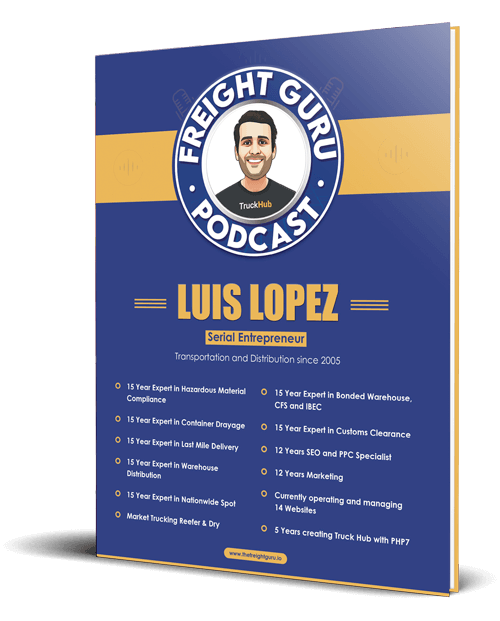
By Luis Lopez, AI transportation consultant, CEO of Go Hub.io Holdings Corp and subsidiaries, and host of the Freight Guru Podcast
Every shipper wants to know the same thing: where is my freight, and when will it actually get there? Predictive ETAs and freight visibility tools claim to answer that better than a phone call to a dispatcher. Some do. Others produce a confident-looking time that turns out to be a guess.
I have worked around South Florida freight for a long time, including container drayage, LTL, truckload, and warehousing. Here is what predictive ETA technology really does, where it helps, and what you should expect when you rely on it.
Tracking is not the same as predicting
These two ideas get blurred together, so let me separate them.
Visibility means seeing the current status of a shipment: its location, its last event, and whether it has picked up or delivered. It is a record of what is happening or has happened.
A predictive ETA is an estimate of a future event, usually arrival time. It uses current status plus other information to forecast what comes next.
Visibility can be accurate without any prediction at all. A predictive ETA is only as good as the visibility underneath it.
How predictive ETAs work
The basic idea is straightforward. A system takes the current location of a truck or shipment, the remaining distance, and the route. A simple tool stops there and divides distance by typical speed. A more advanced tool adds more signals, such as:
- Driver hours of service and required rest breaks
- Historical travel times on that lane at that time of day
- Known facility behavior, such as how long a given warehouse or terminal typically takes to load or unload
- Traffic and weather conditions
- Appointment windows at the destination
Machine learning helps by finding patterns in past trips that a fixed formula would miss. If a certain receiver is routinely slow, or a certain route backs up on certain afternoons, the model can learn that and adjust the estimate.
What the data comes from
Visibility depends on where the location and status data originate. The common categories are:
- Telematics and GPS devices installed on the truck or trailer
- Driver mobile apps that share location while a load is active
- Electronic data interchange and status messages sent between systems at pickup and delivery
- Carrier or terminal updates that are entered manually
Each has strengths and weaknesses. Device data is frequent but can drop out. Manual updates are easy to forget. Mixed sources can disagree. A visibility platform that blends several sources is only as consistent as its weakest feed.
Where predictive ETAs help
Earlier warning on delays
A good tool can flag that a load will miss its window hours before anyone would notice by eye. That gives you time to call the receiver, reschedule an appointment, or arrange labor.
Better planning at the dock
Warehouses and receivers can schedule labor and doors more tightly when they trust arrival estimates. This matters in busy South Florida facilities where a missed appointment can ripple across a whole day.
Where they fall short
Port and terminal uncertainty
For drayage, the hard part is often not the drive. It is the wait at the terminal, container availability, holds, and appointment systems. These are difficult to predict from GPS alone. An ETA that ignores terminal conditions can be badly off.
Sparse or missing signals
If a device loses signal or a driver does not update status, the estimate may freeze or drift. LTL freight that moves through multiple terminals adds more handoffs where visibility can go dark.
Events nobody can forecast
Accidents, breakdowns, weather, and sudden facility problems are not predictable. A model can react quickly, but it cannot see them coming.
False precision
An ETA shown to the minute looks exact. It is really a range. Treat it as a best estimate and ask how wide the uncertainty is.
Data quality
Wrong appointment times, wrong addresses, and inconsistent status codes all feed into the prediction. For more on this, read what AI cannot do in freight data quality.
What to expect from a tool
Realistic expectations will save you frustration. In my view, a solid predictive ETA tool should:
- Update as conditions change rather than showing a fixed time set at dispatch.
- Show the data source and the last update time so you know how fresh it is.
- Indicate confidence or a window, not only a single time.
- Alert you when an ETA moves past an appointment, rather than requiring you to check.
- Let a human add context, such as a known terminal delay.
It should not promise perfect accuracy, and you should be wary of any vendor that does. Ask how accuracy is measured, over what period, and on which lane types. Compare that to your own freight, since a number from a long-haul truckload network may say little about local container moves.
What shippers and carriers should do
If you are a shipper
- Decide what you need visibility for: customer promises, dock planning, or exception management. The answer shapes what you buy.
- Require that carriers can supply consistent status updates, and include that expectation in your carrier agreements.
- Use ETAs to manage exceptions, not to micromanage every load.
If you are a carrier or broker
- Make status updates part of normal driver and dispatcher routine. Technology cannot fix missing inputs.
- Be honest with customers about uncertainty at ports and terminals.
- Check how a visibility feature connects to your existing system. Small fleets should look at what to look for in TMS software for small carriers.
When you evaluate vendors, use a consistent checklist. My guide on how to evaluate an AI vendor for trucking and logistics covers questions worth asking.
The bottom line
Predictive ETAs are a real improvement over a static scheduled time, and visibility tools can reduce phone calls and surface delays earlier. They are still estimates built on imperfect data, and they struggle most where freight is least predictable, such as ports, terminals, and multi-stop moves.
Use them as an early-warning system and a planning aid. Keep a person responsible for the customer relationship, and expect to call the driver or the facility when the stakes are high.
For more on freight and technology, subscribe to the Freight Guru Podcast.
About the author: Luis Lopez is a Miami-based AI transportation consultant and logistics entrepreneur, the CEO of Go Hub.io Holdings Corp and subsidiaries, and host of the Freight Guru Podcast.