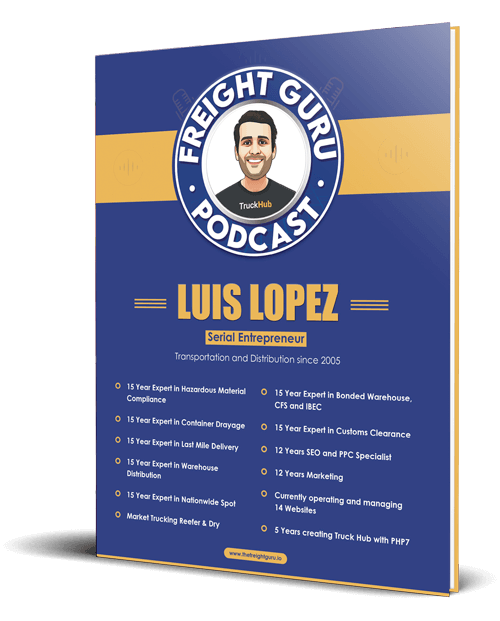
By Luis Lopez, AI transportation consultant, CEO of Go Hub.io Holdings Corp and subsidiaries, and host of the Freight Guru Podcast
When freight is lost, damaged, or involved in a crash, everyone asks the same question: who is responsible? For brokers, the answer is not simple. A broker is not automatically off the hook, and it is not automatically on it. It depends on what the broker did, what the contracts say, and how the broker held itself out.
I have worked in South Florida freight for a long time, across drayage, LTL, truckload, warehousing, and hazmat, and I have seen these roles confused constantly. This article explains the general framework. It is not legal advice, and the details can change by situation and by state.
What a freight broker is
A freight broker arranges transportation of someone else’s freight but does not move it. The broker connects a shipper with a motor carrier and typically earns the difference between what the shipper pays and what the carrier is paid. The carrier actually hauls the load.
To operate legally as a property broker, a company must hold FMCSA broker authority and maintain a financial security requirement of $75,000, met through a surety bond or a trust fund (commonly referred to as BMC-84 and BMC-85). That security exists to protect carriers and shippers if a broker fails to meet certain financial obligations. It is not a general insurance policy against every claim.
Cargo claims: carrier, forwarder, or broker?
Cargo loss and damage on interstate shipments is governed by the Carmack Amendment, 49 U.S.C. 14706. It places liability on the motor carrier, and it also applies to freight forwarders. Generally, it does not apply to a broker that only arranges transportation.
That is the starting point many people remember. But it is only the starting point, for three reasons.
When a broker can be treated like a carrier
Labels do not control. What matters is how the company actually operates and presents itself. A broker that holds itself out as the carrier can be treated as one. That might happen if the company:
- Tells the shipper it will transport the freight itself
- Issues its own bill of lading as the carrier
- Quotes and invoices in a way that suggests it is the party moving the freight
- Uses its own name on paperwork in a way that hides the actual carrier
If a court concludes the company acted as a carrier or forwarder, Carmack liability can follow. For background on the statute itself, read the Carmack Amendment explained.
Liability by contract
Even where Carmack does not apply to a broker by law, a broker can take on cargo liability by agreement. Shipper-broker contracts often assign responsibility for loss and damage to the broker, sometimes with defined limits and procedures. A broker may sign that willingly to win business, without realizing it has effectively accepted carrier-style exposure.
The reverse matters too. The broker-carrier agreement determines what the broker can recover from the carrier that actually caused the loss. Gaps between the two contracts are where brokers get hurt: promising a shipper broad coverage while accepting narrow commitments from the carrier. See broker-carrier agreement clauses that help prevent lawsuits for the provisions worth reviewing.
Negligent selection and crash claims
The more contested area is what happens when a carrier’s driver causes a crash and the injured party sues the broker as well. The typical theory is negligent selection: the broker should not have hired that carrier because it was unsafe, unqualified, or inadequately insured.
Brokers often argue that federal law preempts these claims, since federal law limits state regulation of broker services. Courts have disagreed on how far that preemption goes. Some have allowed negligent-selection claims to proceed, and others have not. Because the law here is unsettled and varies by jurisdiction, nobody should assume a broker is automatically shielded.
The practical takeaway is that how you choose and monitor carriers matters. Good vetting is not only good business. It is also part of how you defend a claim. For the size of exposure that can come from a serious crash, see nuclear verdicts and small fleet protection.
Other situations that create exposure
Double brokering and fraud
If a carrier re-brokers a load to an unknown third party without permission, or a fraudulent operator steals a load by posing as a legitimate carrier, the broker is often caught in the middle. Unclear authority, unpaid carriers, and missing freight can all lead back to the broker’s door. Read double brokering and freight fraud liability for more.
Payment obligations
A broker that collects from the shipper and fails to pay the carrier can face claims from the carrier and from the bond or trust. Payment terms in the contract and the facts of what was agreed will matter.
What brokers should do
- Be clear about your role. Use broker language on quotes, rate confirmations, and paperwork. Do not hold yourself out as the carrier unless you are one.
- Read your shipper contracts closely. Look for cargo liability assignments, limits, indemnities, and claim procedures before you sign.
- Align your contracts. Make sure what you promise the shipper is backed by what the carrier owes you.
- Vet carriers consistently. Verify authority, insurance, and safety history, and document how you decided.
- Control re-brokering. Prohibit it in writing and verify who actually picks up the load.
- Carry appropriate insurance. Ask your agent about coverage that fits brokerage operations, and understand the exclusions. Cargo insurance vs. carrier liability explains how these pieces differ.
What shippers should do
- Ask who is legally responsible for cargo loss in writing, and do not rely on assumptions.
- Check the carrier’s tariff and limits of liability, since they can cap recovery.
- Report damage promptly and follow the claim procedures in your contracts and the carrier’s terms.
The bottom line
A broker is generally not the party liable under Carmack for cargo claims, but that protection is far from absolute. A broker can be treated as a carrier by how it presents itself, can accept liability by contract, and can be drawn into crash and fraud claims on theories that courts have not settled. The safest brokers are clear about their role, careful about carrier selection, and disciplined about the contracts they sign.
For more on freight and technology, subscribe to the Freight Guru Podcast.
About the author: Luis Lopez is a Miami-based AI transportation consultant and logistics entrepreneur, the CEO of Go Hub.io Holdings Corp and subsidiaries, and host of the Freight Guru Podcast.
This article is general information for the freight community, not legal advice. Talk to a transportation attorney about your specific situation.